


import math
import matplotlib.pyplot as plt
import numpy as np
import torch
import torch.nn as nn
from torch.optim import *
from torchvision import models
class Net(nn.Module):
    def __init__(self):
        super(Net,self).__init__()
        self.fc = nn.Linear(1, 10)
    def forward(self,x):
        return self.fc(x)
余弦退火
- 当T_max=20
lrs = []
model = Net()
LR = 0.01
epochs = 100
optimizer = Adam(model.parameters(),lr = LR)
scheduler = lr_scheduler.CosineAnnealingLR(optimizer, T_max=20, eta_min=1e-9)
for epoch in range(epochs):
    optimizer.step()
    lrs.append(optimizer.state_dict()['param_groups'][0]['lr'])
    scheduler.step()

plt.figure(figsize=(10, 6))
plt.plot(lrs, color='r')
plt.text(0, lrs[0], str(lrs[0]))
plt.text(epochs, lrs[-1], str(lrs[-1]))
plt.show()
- 当T_max = epochs,这就是我们经常用到的弦退火的 scheduler,下面再来看看带Warm-up的
lrs = []
model = Net()
LR = 0.01
epochs = 100
optimizer = Adam(model.parameters(),lr = LR)
scheduler = lr_scheduler.CosineAnnealingLR(optimizer, T_max=epochs, eta_min=1e-9)
for epoch in range(epochs):
    optimizer.step()
    lrs.append(optimizer.state_dict()['param_groups'][0]['lr'])
    scheduler.step()

plt.figure(figsize=(10, 6))
plt.plot(lrs, color='r')
plt.text(0, lrs[0], str(lrs[0]))
plt.text(epochs, lrs[-1], str(lrs[-1]))
plt.show()
WarmUp
下面来看看 Pytorch定义的余弦退货的公式如下
η
t
=
η
m
i
n
+
1
2
(
η
m
a
x
−
η
m
i
n
)
(
1
+
cos
(
T
c
u
r
T
m
a
x
π
)
)
,
T
c
u
r
≠
(
2
k
+
1
)
T
m
a
x
;
η
t
+
1
=
η
t
+
1
2
(
η
m
a
x
−
η
m
i
n
)
(
1
−
cos
(
1
T
m
a
x
π
)
)
,
T
c
u
r
=
(
2
k
+
1
)
T
m
a
x
.
begin{aligned} eta_t & = eta_{min} + frac{1}{2}(eta_{max} - eta_{min})left(1 + cosleft(frac{T_{cur}}{T_{max}}piright)right), & T_{cur} neq (2k+1)T_{max}; \ eta_{t+1} & = eta_{t} + frac{1}{2}(eta_{max} - eta_{min}) left(1 - cosleft(frac{1}{T_{max}}piright)right), & T_{cur} = (2k+1)T_{max}. end{aligned}
ηtηt+1=ηmin+21(ηmax−ηmin)(1+cos(TmaxTcurπ)),=ηt+21(ηmax−ηmin)(1−cos(Tmax1π)),Tcur=(2k+1)Tmax;Tcur=(2k+1)Tmax.
实际上是用下面的公式做为更新的, 当 T c u r = T m a x T_{cur} = T_{max} Tcur=Tmax是, c o s cos cos部分为0,所以就等于 η m i n eta_{min} ηmin
η t = η m i n + 1 2 ( η m a x − η m i n ) ( 1 + cos ( T c u r T m a x π ) ) eta_t = eta_{min} + frac{1}{2}(eta_{max} - eta_{min})left(1 + cosleft(frac{T_{cur}}{T_{max}}piright)right) ηt=ηmin+21(ηmax−ηmin)(1+cos(TmaxTcurπ))
这里直接根据公式的定义来画个图看看etas = []
epochs = 100
eta_max = 1e-4
eta_min = 1e-9
t_max = epochs / 1
for i in range(epoch):
t_cur = i
eta = eta_min + 0.5 * (eta_max - eta_min) * (1 + np.cos(np.pi * t_cur / t_max))
etas.append(eta)
plt.figure(figsize=(10, 6))
plt.plot(range(len(etas)), etas, color='r')
plt.text(epochs, lrs[-1], str(lrs[-1]))
plt.show()
从图上来看,跟上面的余弦退化是一样的,眼尖的都会发现lr_min 不等于eta_min=1e-9
有个较小的bug(也不算,在description里有指出)
def warm_up_cosine_lr_scheduler(optimizer, epochs=100, warm_up_epochs=5, eta_min=1e-9):
    """
    Description:
        - Warm up cosin learning rate scheduler, first epoch lr is too small

    Arguments:
        - optimizer: input optimizer for the training
        - epochs: int, total epochs for your training, default is 100. NOTE: you should pass correct epochs for your training
        - warm_up_epochs: int, default is 5, which mean the lr will be warm up for 5 epochs. if warm_up_epochs=0, means no need
          to warn up, will be as cosine lr scheduler
        - eta_min: float, setup ConsinAnnealingLR eta_min while warm_up_epochs = 0

    Returns:
        - scheduler
    """

    if warm_up_epochs <= 0:
        scheduler = torch.optim.lr_scheduler.CosineAnnealingLR(optimizer, T_max=epochs, eta_min=eta_min)

    else:
        warm_up_with_cosine_lr = lambda epoch: eta_min + (epoch / warm_up_epochs) if epoch <= warm_up_epochs else 0.5 * (
            np.cos((epoch - warm_up_epochs) / (epochs - warm_up_epochs) * np.pi) + 1)
        scheduler = torch.optim.lr_scheduler.LambdaLR(optimizer, lr_lambda=warm_up_with_cosine_lr)

    return scheduler
# warm up consin lr scheduler
lrs = []
model = Net()
LR = 1e-4
warm_up_epochs = 30
epochs = 100
optimizer = SGD(model.parameters(), lr=LR)
scheduler = warm_up_cosine_lr_scheduler(optimizer, warm_up_epochs=warm_up_epochs, eta_min=1e-9)
for epoch in range(epochs):
optimizer.step()
lrs.append(optimizer.state_dict()['param_groups'][0]['lr'])
scheduler.step()
plt.figure(figsize=(10, 6)) 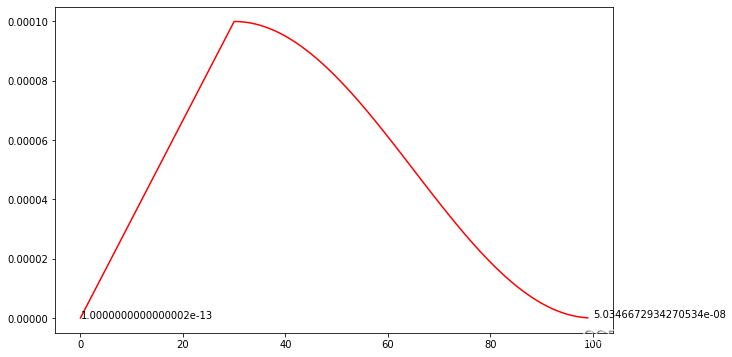
plt.plot(lrs, color='r')
plt.text(0, lrs[0], str(lrs[0]))
plt.text(epochs, lrs[-1], str(lrs[-1]))
plt.show()
从图上看,第一个lr非常非常小,导致训练时的,第一个epoch基本上不更新
class WarmupCosineLR(lr_scheduler._LRScheduler):
    def __init__(self, optimizer, lr_min, lr_max, warm_up=0, T_max=10, start_ratio=0.1):
        """
        Description:
            - get warmup consine lr scheduler

        Arguments:
            - optimizer: (torch.optim.*), torch optimizer
            - lr_min: (float), minimum learning rate
            - lr_max: (float), maximum learning rate
            - warm_up: (int),  warm_up epoch or iteration
            - T_max: (int), maximum epoch or iteration
            - start_ratio: (float), to control epoch 0 lr, if ratio=0, then epoch 0 lr is lr_min

        Example:
            <<< epochs = 100
            <<< warm_up = 5
            <<< cosine_lr = WarmupCosineLR(optimizer, 1e-9, 1e-3, warm_up, epochs)
            <<< lrs = []
            <<< for epoch in range(epochs):
            <<<     optimizer.step()
            <<<     lrs.append(optimizer.state_dict()['param_groups'][0]['lr'])
            <<<     cosine_lr.step()
            <<< plt.plot(lrs, color='r')
            <<< plt.show()

        """
        self.lr_min = lr_min
        self.lr_max = lr_max
        self.warm_up = warm_up
        self.T_max = T_max
        self.start_ratio = start_ratio
        self.cur = 0    # current epoch or iteration

        super().__init__(optimizer, -1)

    def get_lr(self):
        if (self.warm_up == 0) & (self.cur == 0):
            lr = self.lr_max
        elif (self.warm_up != 0) & (self.cur <= self.warm_up):
            if self.cur == 0:
                lr = self.lr_min + (self.lr_max - self.lr_min) * (self.cur + self.start_ratio) / self.warm_up
            else:
                lr = self.lr_min + (self.lr_max - self.lr_min) * (self.cur) / self.warm_up
                # print(f'{self.cur} -> {lr}')
        else:
            # this works fine
            lr = self.lr_min + (self.lr_max - self.lr_min) * 0.5 *
                            (np.cos((self.cur - self.warm_up) / (self.T_max - self.warm_up) * np.pi) + 1)

        self.cur += 1

        return [lr for base_lr in self.base_lrs]
# class
epochs = 100
warm_up = 5
cosine_lr = WarmupCosineLR(optimizer, 1e-9, 1e-3, warm_up, epochs, 0.1)
lrs = []
for epoch in range(epochs):
    optimizer.step()
    lrs.append(optimizer.state_dict()['param_groups'][0]['lr'])
    cosine_lr.step()

plt.figure(figsize=(10, 6))
plt.plot(lrs, color='r')
plt.text(0, lrs[0], str(lrs[0]))
plt.text(epochs, lrs[-1], str(lrs[-1]))
plt.show()
从图上看出,第一个epoch的lr也不到于非常非常小了,达到了所需预期,



