


题文
Eyeglasses correct many different types of sight problems, including nearsightedness, farsightedness or astigmatism (散光). Trying to understand those different numbers on an eyeglass prescription (验光单) requires understanding the measurements optometrists (验光师) use when fitting you for corrective lenses (镜片).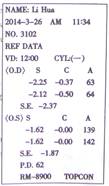
Diopters (屈光度)
The numbers on your prescription are given in diopters, whose short form is "D". It is used to measure the focusing power, or amount of correction.
O.S. and O.D.
Optometrists use the Latin short form O.S. and O.D. to distinguish between your eyes. O.S. refers to your left eye, while O.D. refers to the right eye.
Generally, your prescription will show a number for O.S. and O.D. (given in diopters). The farther this number is on a number line from zero, the more correction your eyeglasses should provide. A plus sign means the eye is farsighted, while a minus sign means the eye is nearsighted.
Spherical Value
This plus or minus number for each eye is called the spherical value, or the degree of nearsightedness or farsightedness you have. Its short form is "S."
Cylinder
If you have an astigmatism, the optometrist will also measure its degree. The higher the number (given in diopters) marked as the cylinder of astigmatism, (its short form is "C"), the more astigmatism there is in that eye.
Axis
An astigmatism is also measured in terms of its axis, which is a number between 0 and 180. The axis of the astigmatism does not relate to the amount of cylinder, just the location of the irregularity of the astigmatism on that particular eye.
小题1:According to the first paragraph, various sight problems ______.A.should be understood by the patientsB.can be avoided by wearing corrective lensesC.should be tested by different optometristsD.can be corrected by wearing eyeglasses小题2:If you need a pair of corrective lenses, the optometrist will first value the numbers of ______.A.DioptersB.Spherical ValueC.CylinderD.Axis小题3:From the prescription above we can learn that Li Hua ______.A.is farsightedB.is nearsightedC.has no astigmatismD.is normal in sight小题4:The text is probably taken from ______.A.an education reportB.a school bulletinC.a local newspaperD.an encyclopedia (百科全书) 题型:未知难度:其他题型
答案
小题1:D
小题2:A
小题3:B
小题4:D
解析
文章介绍了怎么样看验光师的处方,上面的符号和数字都是什么含义,让人们更好的了解自己的眼睛,配一副合适的镜片。
小题1:细节题:从文章的句子:可知各种各样的视力问题,可以通过戴眼镜纠正,选D
小题2:细节题:从第二段的句子;The numbers on your prescription are given in diopters, whose short form is "D". It is used to measure the focusing power, or amount of correction.可知如果你想配一副适合的镜片,验光师会首先验你的眼睛屈光度,选A。
小题3:细节题:从第四段的句子:while a minus sign means the eye is nearsighted.可知OS和OD的数字是负的,说明是近视眼,再根据李华的处方,可知李华是近视眼。选B
小题4:文章出处题:文章介绍了怎么样看验光师的处方,上面的符号和数字都是什么含义,让人们更好的知道这些知识,所以应该是百科全书里面的内容。选D
考点
据考高分专家说,试题“Eyeglasses correct m.....”主要考查你对 [日常生活类阅读 ]考点的理解。日常生活类阅读
日常生活类阅读的概念:
日常生活这一话题主要涉及人们衣食住行等方面的活动。这一话题的选材主要针对人们日常的工作,生活以及学习情况。做这一类题时,最主要的是要把握好人物的活动内容,时间和地点。
日常生活类阅读题答题技巧:
【题型说明】
该类文章内容涉及到人们的言谈举止、生活习惯、饮食起居、服饰仪表、恋爱婚姻、消遣娱乐、节日起源、家庭生活等。文章篇幅短小,追根溯源,探索各项风俗的历史渊源,内容有趣。命题也以送分题为主,如事实细节题、语义转换题、词义猜测题和简单推理判断题等。虽然这类文章读起来感觉轻松,试题做起来比较顺手,但绝不能掉以轻心。因为稍不留神,就会丢分。
【备考提醒】
为了保证较高准确率,建议同学们做好以下几点:
1、保持正常的考试心态。笔者在教学中发现,越是容易的试题,同学们越是容易失分。为什么呢?因为在这种情况下,同学们极易产生麻痹思想,认为题目好做,就不引起高度重视,于是思维不发散、不周密。而命题人就是利用同学们的这一弱点,设计陷阱题。所以,无论试题难易与否,我们都要保持正常的考试心态。试题容易,不欣喜;试题难,不悲观。
2、根据前面讲到的方法,认认真真、细细心心做好事实细节题。
3、做好语义转换题。这类题是根据英语中一词多义和某些词语在文中能表达一定的修辞意义的原则而设计的。要求同学们解释某生词的含义,确定多义词或短语在文中的意思,确认文中的某个代词所指代的对象,或者对英语中特有的表达、格言、谚语进行解释。这种题要求同学们一定要根据上下文猜测词义或理解句子,切不可望文生义。
4、做好简单推理判断题。简单推理判断题要以表面文字为前提,以具体事实为依据进行推理,做出判断。这种推理方式比较直接,只要弄清事实,即可结合常识推断出合理的结论。



