


题文
阅读理解。 You're in a bit of a dilemma standing in front of the produce section of your local supermarket.
In one hand, you're holding a conventionally grown Granny Smith apple. In your other hand, you
have one that's been organically grown. Both apples are firm, shiny and green. Both provide vitamins
and fiber, and both are free of fat, sodium and cholesterol.
The conventionally grown apple costs less and is a proven family favorite. But the organic apple
has a label that says "USDA Organic". Does that mean it's better? Safer? More nutritious? Become
a better informed consumer for your next trip to the supermarket. Several differences between
organic and non-organic foods exist. The word "organic" refers to the way farmers grow and process
agricultural products, such as fruits, vegetables, grains, dairy products and meat. Organic farming
practices are designed to encourage soil and water conservation and reduce pollution. Farmers who
grow organic produce and meat don't use conventional methods to fertilize, control weeds or prevent
livestock disease.
Here are other differences between conventional farming and organic farming:
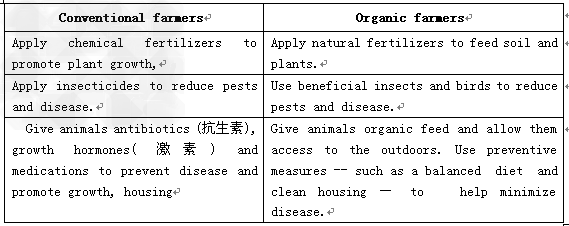
* Organic or not? Check the label
The U.S. Department of Agriculture (USDA) has established an organic certification program
that requires all organic foods to meet strict government standards. These standards regulate how
such foods are grown, handled and processed. Any farmer or food manufacturer who labels and
sells a product as organic must be USDA certified as meeting these standards. only producers who
sell less than $5,000 a year in organic foods are exempt(免除) from this certification.
If a food bears a USDA Organic label, it means it's produced and processed according to the
USDA standards. The seal is voluntary, but many organic producers use it.
答案
1-5CDDBA解析
该题暂无解析
考点
据考高分专家说,试题“阅读理解。 Yo.....”主要考查你对 [健康环保类阅读 ]考点的理解。健康环保类阅读
健康环保累阅读概念:
健康环保类文章常是介绍科学知识、生活常识和环境保护方面的短文。体裁有记叙文、 说明文、议论文和各种应用文。
健康环保类文章阅读技巧:
健康环保类文章常是介绍科学知识、生活常识和环境保护方面的短文。阅读此类短文要以现象或事物为中心进行思考,理解现象产生的原因、条件和客观规律等。同时要抓住事物的特征、用途和相互关系等。科普环保类文章一般为说明文,从结构上看大致可分为三个部分:
第一部分一般是文章的首段,主要用来提出文章的主题,即文章想要阐述、说明的主要内容;
第二部分是文章的主体,可由若干个段落组成,对文章的主题进行展开说明;
第三部分是结尾段,对文章的主题进行归纳总结。这类文章多用一般现在时,而且一般多使用客观性词语表述。有时为了强调客观性,也常使用被动语态。
从近几年的考试题来看,科普环保类的文章越来越与人们的实际生活相接近。由于此类文章缺乏故事情节,很多同学对此类文章感到费解。但一般的科普类文章都是就事论事,需要逻辑推理和想象的时候较少,因此此类阅读题也没有同学们想象中的那么难,只要多加训练,就能较好地答题。
【阅读策略】
1、概要(Summarizing):
阅完材料后,将所阅材料浓缩,摘要,做出所阅材料的书面或口头梗概。
2、组织(Organization):
阅读后根据阅读内容,识别观点、人物、事件之间的关系以及文章的结构关系。如:时间关系、比较或对比关系、相关关系及因果关系等。



