


题文
Directions: Read the following passage. Fill in the numbered blanks by using the information fromthe passage.
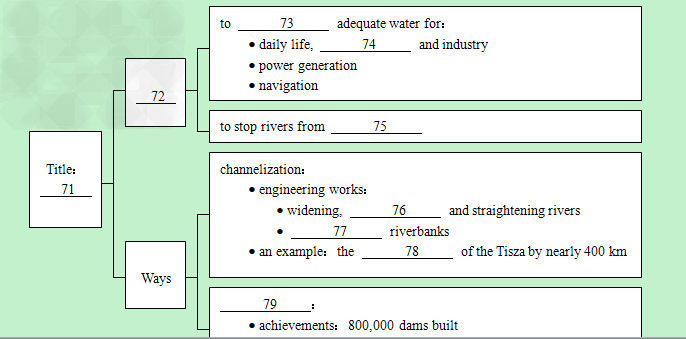
Write NO MORE THAN THREE WORDS for each answer. Since the earliest civilizations, people have controlled rivers to meet society's demands. Today, rivers
are controlled for many reasons, primarily to maintain reliable water supplies for daily, agricultural and
industrial needs, for power generation, for navigation (航行), and to prevent flooding.
River control is achieved by channelization, a term that covers a range of river engineering works, including
widening, deepening, straightening and stabilization of banks, and by the construction of dams.
An important period of channelization took place in Europe during the 19th century, when many large rivers
were straightened and their beds deepened. One of the most dramatically changed was the Tisza River, a branch
of the Danube that flows through Hungary. The controlling of the Tisza, designed to reduce flooding and make
land for agriculture, included cutting off more than 100 meanders (河曲), shortening the river's length by nearly
400 kilometers.
One of the most common ways in which people control rivers is by damming them. The past 50 years or so
has seen an increase in dam construction worldwide, and at the beginning of the 21st century, there were about
800,000 dams globally, some towering more than 200 meters in height.
Despite their successes, many dams also cause significant environmental changes that prove harmful. Some
particularly deep reservoirs (水库) can bring about earthquakes due to the stress on their bottom rocks caused
by huge volumes of water. Downstream of a reservoir, the river is certainly influenced in many ways:water
volume, speed and quality are all affected, leading to changes in the landscape and among plants and animals.
题型:未知难度:其他题型
答案
1. River Control2. Reasons
3. supply
4. agriculture
5. flooding
6. deepening
7. stabilizing
8. shortening
9. dam construction
10. the environment
解析
该题暂无解析
考点
据考高分专家说,试题“ Directions: R.....”主要考查你对 [历史文化类阅读 ]考点的理解。历史文化类阅读
什么是历史文化类阅读:
本类题型常用的方式是夹叙夹议。叙述的目的是为了议,所以要把握其议才是主要方面。阅读这类文章,先弄清其引入的话题,再弄清里面人物对其不同的看法,然后理解作者本身对话题的观点看法或思考。
历史文化类阅读技巧:
【题型说明】历史文化类阅读理解文章属高考常选材料之一。这类文章常涉及历史、文化、法制、宗教等方面的文学艺术、发明创造、文化遗产保护、宗教与文化、风俗与习惯、道德与法制、中外文学名著节选、等等。这类材料的命题点往往落在主旨大意题、事实细节题上。
【答题方法】在做这类阅读理解题时,我们应注意以下几个方面:
1、采用先题后文:先读题目,再带着问题读文章。这类阅读理解文章相对来说事实细节题稍多一点,如果带着问题读文章,有利于我们抓细节。
2、先做细节题。因为做完了局部性的事实细节题后,自然会加深我们对文章的理解,这样更有利于做主旨大意题。
3、重点敲定主旨题。主旨大意题提问的形式主要有两大类:一类是Main idea型;一类是Topic或Title型。
在解答这类试题时应注意以下几点:
a.读首句抓大意。
文化教育类阅读理解文章多采用说明文、议论文体裁,而这类文章大都采用文章段落的中心,即主题句在文章开头。因此,要寻找这类文章的主旨大意就需要研究文章的首句。
b.读尾句抓大意。
有时这类文章的主题句安排在文章的结尾,作为对全篇的总结。
c.读首段抓大意。
有些文章或段落的开头和结尾部分都有主题句。这种结构是为了突出主题思想而使用两次点题的写作方法。这两个主题句在句子结构和用词上有所不同,而且在内容上前句和后句也不重复。
d.从段落中抓大意。
有些文章或段落的主题句在文章中,这种文章或段落往往以一句话或几句话引出要表达的主题,在主题句出现后,再举例子陈述细节或继续论证。
e.归纳要点抓大意。
有些文章或段落无明显的主题句,只是暗示性地体现主题。这就要求同学们在阅读过程中根据文中所叙述的事实或线索来概括总结主旨大意。



