


题文
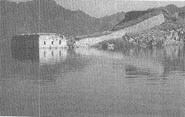
The Great Wall of China is one of Beijing’s biggest draws for

tourists; despite its fame and ubiquity in postcards across the world, it rarely fails to attract tourists at the first proper sight.Yet the authorities open only certain sections of the wall as fit for viewing, and few get to visit the unauthorized sections. Fewer still are aware of the existence of at least one part of the Wall that remains in almost original condition, nearly 1,500 years after construction of legendary fortification began. But there’s a good reason for this – it’s underwater.
American journalist Steven Schwankert has been diving since age 10. It was though his setting – up of a diving school that Schwankert came to explore some of lesser – known areas of China’s lakes – and discovered the underwater Wall under a reservoir. “The most fascinating piece of diving I ever did in China must be the Great Wall. I managed to find out about it via the Internet. It wasn’t difficult to get to Pan Jiakou in Hebei Province, near the East Qing Tomb about 4 hour’s drive from Beijing. Why do I want to dive the Great Wall? Why do people want to walk on the Great Wall? It’s the same answer.”
There are, however, advantages of visiting the Great Wall in a diving suit over being on foot. The water acts as a preservative by preventing the kind of mass tourism that has brought trouble on other parts of the Wall. “Unlike the people who walk in the Wall, we as divers never need to actually touch it. I’ve dived twice there, the last time in July. I found that the water then was much deeper than it was before – 13 meters deep.” When he first dived, parts of the Wall were visible above the surface. Now even the guard tower is completely submerged. “It’s better that the Wall is deep under water, as there are lots of boats coming in and out around that area. Their wave action could potentially damage the brickwork. So, the deeper, the better.”
1.Steven Schwankert is most interested in .
A.collecting photos of the Wall B.walking along on the Wall
C.diving the underwater Wall D.visiting some famous lakes
2.What does the underlined word “submerged” in Paragraph 5 most probably mean?
A.Damaged by water. B.Washed by water.
C.Preserved by water. D.Covered by water.
3.What is the topic discussed in the last paragraph?
A.Advantages of walking on the Great Wall.
B.Advantages of visiting the underwater Wall.
C.The reasons why the Wall is deep under water.
D.The reasons why the underwater Wall is protected.
4.What can we infer from the text?
A.The underwater Wall will sink deeper year by year.
B.Diving the Wall is popular with divers all over the world.
C.Diving is a good way to visit the Wall without causing much damage.
D.More and more tourists will come to visit the underwater Wall in China. 题型:未知 难度:其他题型
答案
小题1:C
小题2:D
小题3:B
小题4:C
解析
略考点
据考高分专家说,试题“The Great Wall of Ch.....”主要考查你对 [政治经济类阅读 ]考点的理解。政治经济类阅读
政治经济类文章的概念:
要做好这类阅读,平时就要注意了解国内外发生的政治经济大事,掌握一定背景知识,对这类文章的叙述特点及内容安排有一定了解,还要扩展这方面的词汇。阅读这类文章,要抓住文章的核心,即文章整体和各段主要在说什么,也要注意段落之间的逻辑关系。
如何备考政治经济类阅读理解题:
【题型说明】政治经济类阅读文章是高考常选材料之一。该类文章时代气息浓郁,语言鲜活,但熟字新义词、超纲词及专业词语多,长句、难句多。政治类文章大多数是同学们感性趣的内容,读起来倒有似曾相识的感觉,经济类文章读起来就像是雾里看花,文章看完,一头雾水。再加之这类文章的命题侧重于词义猜测、推理判断和文章主旨,同学们对这类题材是望而生畏。
【备考策略】建立心理优势。针对不同体裁的文章,我们要采取相应的阅读方法和技巧。政治类文章多采用记叙文形式,我们可采取“顺读法”,以便抓关键语句,领会文章主旨;而经济类文章则多采用说明文形式,我们则可以采取“逆读法”,先读试题,再从文章中查找有用信息。若遇到的确难读的材料。千万不用着急,因为你觉得难,其他人也一定是同感。在高考前,我们就要有这种心理准备,高考试卷肯定有一、两篇难以阅读的材料。不过,我们平时可以有意识地从报刊杂志上找一些较难的阅读材料来阅读,以培养自己迎难而上的心理素质。
【答题方法】
1、寻找主干:
根据英语中五种基本句型结构,把句子中的主语、谓语、宾语、表语等主要成分找出来,其他成分如定语、状语、补语等则易于理解。找到了句子主干,句子的意思至少明白了一半。
2、剔除从句:
在一个长句中可能会出现若干个从句,在理解时,如果把各个从句剔除出来单独理解,然后把大意拼凑起来,整个长句的意思就会明白六、七分。
3、辨别分句:
一个长句如果是由几个并列、转折、递进、对比关系的分句组成,句中往往有表示这些分句关系的连接词,只要能弄清楚分句和分句之间的逻辑关系,再把各层分句的意思加以连贯,整个长句的句意基本上能跃然脑中。
4、寻找关键词:
如果一个句子看完,一点句意的感觉也没有,下下策就是抓住句中的关键词,通过关键词大体弄懂这个长句的意思。



