


题文
Some expressions in English can be really puzzling. Have a look at the following to see how it challenges your brainpower.Homeric laughter
The "Homer" in this expression is the Greek poet. People laugh differently. Some laugh silently, while others tend to laugh loudly. "Homeric laughter" refers to laughter of the latter kind. It is at times uncontrollable, and the entire body shakes during the process. This kind of laughter is called Homeric laughter because this is how the gods laughed in Homer's classics.
A three-ring circus
When you refer to a situation as being a three-ring circus, you are saying that it is a situation of complete confusion. There are so many activities taking place all together that they leave you confused or annoyed. The expression comes from the world of entertainment — the circus. The area where the artists perform their acts is called the "ring". In the past, some of the circuses were so grand that they had three acts taking place simultaneously in three different "rings". The audience had to decide which "ring" they wanted to focus on.
In the swim (of things)
When someone is in the swim of things, the individual is actively participating in the things happening around him, as in "I've been ill, but soon I’ll be back in the swim of thing." In the world of fishing, fishermen use the word "swim" to refer to the section of the lake/river where fish can be found in plenty. So, if you are a fisherman and wish to catch a lot offish, where would you be? You would be "in the swim".
Chickens have come home to roost
The word "roost" refers to the place where birds rest. It could be anything — the branch of a tree, a henhouse, etc. The expression is normally used to mean that the bad things that someone did in the past have come back to bite or upset the individual. In other words, one has to face the consequences of the deeds done in the past. The original form of this 700-year-old expression was "curses are like chickens; they always come home to roost".
小题1:Which of the following can best describe the picture?
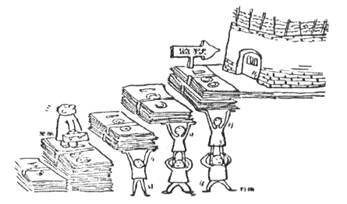
A.Homeric laughterB.A three-ring circusC.In the swim (of things)D.Chickens have come home to roost小题2:What does the underlined word "simultaneously'(Paragraph 3) mean?A.At the same time.B.Step by step.C.All of a sudden.D.One after another.小题3:lf you want to know more about such expressions, which website will you probably visit?A.www.chinadaily.com.cn/sports/China.htmlB.www.chinadaily.com.cn/world/university.htmlC.www.chinadaily.com.cn/culuture/language.htmlD.www.chinadaily.com.cn/entertainment/fashion.html小题4:The passage is written to .A.tell readers some old and interesting storiesB.indicate the development of English phrasesC.correct some misunderstandings about wordsD.explain the meanings and origins of some phrases 题型:未知 难度:其他题型
答案
小题1:D
小题2:A
小题3:C
小题4:D
解析
本文告诉我们一些令人迷惑的英语表达的意思及来历。小题1:D 推断题。从本图中可知,那些送给他的钱一步步地把他送进了监狱,所以符合最后一个成语的意思:善有善报,恶有恶报;害人终害己。
小题2:A 词义猜测题。In the past, some of the circuses were so grand that they had three acts taking place simultaneously in three different "rings".意思是:在过去,马戏团是如此的宏伟,可以共三套节目同时进行。
小题3:C推断题。本文跟语言有关,故选C。
小题4:D 主旨大意题。本文要解释一些短语的意义及来源。故D项正确。
考点
据考高分专家说,试题“Some expressions in .....”主要考查你对 [社会现象类阅读 ]考点的理解。社会现象类阅读
社会现象类阅读概念:
这类文章通过写人记事来揭示文章的主题,显示其社会意义,一般采用顺序或倒叙来叙述。题目经常是一些细节问题。考查的方面可以是原因和其中引发的思考。
社会现象类阅读解题技巧:
这类文章通过写人记事来揭示文章的主题,显示其社会意义,一般采用顺序或倒叙来叙述。题目经常是一些细节问题。考查的方面可以是原因和其中引发的思考。阅读这类文章要理清思路。
1、浏览试题,明确要求。
在阅读文章前,最好先浏览一下文章后面的题干和选项。知道了问题后再去看文章,可使思路更敏捷,而且也便于阅读时留意文中出现的与选项有关的信息。
2、通读全文,抓住主要内容。
在不影响理解的前提下,尽可能地阅读以便在尽可能短的时间内理解文章或段落的内容。阅读时,如遇到不熟悉的单词、词组或一时看不懂的句子,不要停下来苦思冥想,继续读下去,通过上下文的词语和句子可能就理解了。
3、抓住中心思想和段落大意。
通读全文时,要特别注意主题句。每篇文章或每个段落都有与文章有关的句子,尤其是科技、政论性文章的主题句一般都在文章的开头或结尾,插在中间的很少。所以,文章的第一段或开头的第一、二个句子往往包含着文章的中心思想、作者的意图或全文的概述,因此要特别注意,彻底理解。
4、有针对性地仔细阅读,找寻所需信息。
在前面的基础上,可进行有针对性地阅读了。把与问题无关的内容一扫而过,而对于和问题有关的内容认真阅读,还可以用笔在下面做出记号。再把这些信息与问题的要求结合起来,逐条分析,综合判断,找出正确答案。
5、进行合理的推理判断。
对文章有了全面的了解之后,可以按照文章要求以及上下文之间的关系,做出推理判断。在进行推理判断的时候,需要综合考虑句型、语法、句子之间的逻辑关系、文化背景等方面的因素。
6、认真复读,验证答案。
要用全文的中心思想统帅各个题目,研究其内在联系和逻辑关系,并依次审核那些还未打上的题目,确保理解无误。



