


题文
“The lift becomes this interesting social space where etiquette (礼仪) is sort of odd (奇怪的),” Gray told the BBC. “They [elevators] are socially very interesting but often very awkward places.”
We walk in and usually turn around to face the door. If someone else comes in, we may have to move. And here, according to Gray, liftusers unthinkingly go through a set pattern of movements. He told the BBC what he had observed.
He explained that when you are the only one inside a lift, you can do whatever you want – it’s your own little box.
If there are two of you, you go into different corners, standing diagonally (对角线地) across from each other to create distance.
When a third person enters, you will unconsciously form a triangle. And when there is a fourth person it becomes a square, with someone in every corner. A fifth person is probably going to have to stand in the middle.
New entrants to the lift will need to size up the situation when the doors slide open and then act decisively. once in, for most people the rule is simple – look down, or look at your phone.
Why are we so awkward in lifts?
“You don’t have enough space,” Professor Babette Renneberg, a clinical psychologist at the Free University of Berlin, told the BBC. “Usually when we meet other people we have about an arm’s length of distance between us. And that’s not possible in most elevators.”
In such a small, enclosed space it becomes very important to act in a way that cannot be construed (理解) as threatening or odd. “The easiest way to do this is to avoid eye contact,” she said.
小题1:The main purpose of the article is to _____.A.remind us to enjoy ourselves in the elevatorB.tell us some unwritten rules of elevator etiquetteC.share an interesting but awkward elevator rideD.analyze what makes people feel awkward in an elevator小题2:According to Gray, when people enter an elevator, they usually _____.A.turn around and greet one anotherB.look around or examine their phoneC.make eye contact with those in the elevatorD.try to keep a distance from other people小题3:Which of the following describes how people usually stand when there are at least two people in an elevator?
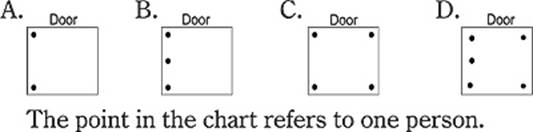
小题4:The underlined phrase “size up” in Paragraph 7 is closest in meaning to _____.A.judgeB.ignoreC.put up withD.make the best of小题5:According to the article, people feel awkward in lifts because of _____.A.someone’s odd behaviorsB.the lack of spaceC.their unfamiliarity with one anotherD.their eye contact with one another 题型:未知 难度:其他题型
答案
小题1:B
小题2:D
小题3:C
小题4:A
小题5:B
解析
本文作者叙述了乘坐电梯的人的礼仪,由于电梯的空间小,人们进去之后如果有两个人就各自站一个角,如果有三个人人们往往就站成对角线,如果是四个人他们就站在四个角,五个人时那个人就站在中间,彼此之间都常常保持一定的距离,避免眼的接触,有的人向下看或者玩弄手机。小题1:作者意图题。根据The lift becomes this interesting social space where etiquette (礼仪) is sort of odd (奇怪的),” Gray told the BBC. “They [elevators] are socially very interesting but often very awkward places.及短文的大意可知告诉我们一些电梯不成文的礼仪,故选B。
小题2:细节理解题。根据If there are two of you, you go into different corners, standing diagonally (对角线地) across from each other to create distance.试图彼此之间要保持一定的距离,故选D。
小题3:细节理解题。根据when there is a fourth person it becomes a square, with someone in every corner. 当有四个人在电梯中的时候经常这四个人各站一个角,故选C。
小题4:词义猜测题。根据when the doors slide open and then act decisively需要及时判断情况找好自己的位置,故选A。
小题5:细节理解题。根据Why are we so awkward in lifts? “You don’t have enough space,” 因为没有足够的空间,故选B。
考点: 考点
据考高分专家说,试题“You may not pay much.....”主要考查你对 [社会现象类阅读 ]考点的理解。社会现象类阅读
社会现象类阅读概念:
这类文章通过写人记事来揭示文章的主题,显示其社会意义,一般采用顺序或倒叙来叙述。题目经常是一些细节问题。考查的方面可以是原因和其中引发的思考。
社会现象类阅读解题技巧:
这类文章通过写人记事来揭示文章的主题,显示其社会意义,一般采用顺序或倒叙来叙述。题目经常是一些细节问题。考查的方面可以是原因和其中引发的思考。阅读这类文章要理清思路。
1、浏览试题,明确要求。
在阅读文章前,最好先浏览一下文章后面的题干和选项。知道了问题后再去看文章,可使思路更敏捷,而且也便于阅读时留意文中出现的与选项有关的信息。
2、通读全文,抓住主要内容。
在不影响理解的前提下,尽可能地阅读以便在尽可能短的时间内理解文章或段落的内容。阅读时,如遇到不熟悉的单词、词组或一时看不懂的句子,不要停下来苦思冥想,继续读下去,通过上下文的词语和句子可能就理解了。
3、抓住中心思想和段落大意。
通读全文时,要特别注意主题句。每篇文章或每个段落都有与文章有关的句子,尤其是科技、政论性文章的主题句一般都在文章的开头或结尾,插在中间的很少。所以,文章的第一段或开头的第一、二个句子往往包含着文章的中心思想、作者的意图或全文的概述,因此要特别注意,彻底理解。
4、有针对性地仔细阅读,找寻所需信息。
在前面的基础上,可进行有针对性地阅读了。把与问题无关的内容一扫而过,而对于和问题有关的内容认真阅读,还可以用笔在下面做出记号。再把这些信息与问题的要求结合起来,逐条分析,综合判断,找出正确答案。
5、进行合理的推理判断。
对文章有了全面的了解之后,可以按照文章要求以及上下文之间的关系,做出推理判断。在进行推理判断的时候,需要综合考虑句型、语法、句子之间的逻辑关系、文化背景等方面的因素。
6、认真复读,验证答案。
要用全文的中心思想统帅各个题目,研究其内在联系和逻辑关系,并依次审核那些还未打上的题目,确保理解无误。



