


题文
Coffee has become a popular drink in our culture. Most people have a coffee maker at home for guests who come to visit. It naturally contains caffeine (咖啡因), which people in today’s society have somewhat come to rely on (依靠) to provide them with energy.In the workplace many people start their day with a cup of coffee, and then continue to drink it until it’s time to go home. Many meetings also begin with a cup of coffee --- which is why so many workplaces now have a steady flow of office coffee.
Coffee is unsurprisingly one of the most traded agricultural products in the world, supporting the economy in many countries. Coffee is made from the roasted(烤,烘,焙) seeds of coffee cherries, which grow on trees in over 70 countries. The seeds are roasted to different degrees depending on the flavors wanted, and then are brewed (泡,煮) to create the coffee drink. Coffee is usually sold already roasted, so that all you have to do is add hot water.
Coffee is labeled according to its appearance --- light, medium light, medium, medium dark, dark, or very dark.
People argue a lot about whether the effect of drinking coffee is positive or negative. Some people think that drinking too much coffee is bad for our health. But you can buy decaffeinated (脱去咖啡因的) coffee, which has a lot less caffeine. Most people, however, would not care about the negative effects of drinking coffee.
Title: Coffee --- A Modern Trend
The reason for coffee’s popularity
containing caffeine which makes people 小题1: ______
The places where people drink coffee
●providing coffee for 小题2: __________ at home
●drinking coffee 小题3:_____________
The coffee-making 小题4: ___________
●made from seeds on coffee trees
●roasted to create coffee drinks
●mixed with 小题5: ________ before it is drunk
The category of coffee
●classified based on its 小题6:__________
People’s attitude towards the
小题7: _________ of coffee
●arguing as to whether drinking coffee is小题8: ________
●worrying about the risk of drinking 小题9: __________
●小题10:______ the side effect of drinking coffee
题型:未知难度:其他题型
答案
小题1:energetic
小题2:(visiting) guests
小题3:in the workplace
小题4:process
小题5:water
小题6:appearance
小题7:effect
小题8:positive or negative
小题9:too much coffee
小题10:ignoring/not caring about
点击查看序数词知识点讲解,巩固学习
解析
文章大意:本文着重讲述了现代生活的趋势——咖啡越来越受到人们的欢迎。
小题1:energetic 词性转换。根据第一段It naturally contains caffeine (咖啡因), which people in today’s society have somewhat come to rely on (依靠) to provide them with energy.中的energy转换为形容词。
小题2:(visiting) guests 原词再现。根据第一段Most people have a coffee maker at home for guests who come to visit.可以得出,注意for为介词。
小题3:in the workplace 原词再现。根据文章第二段首句In the workplace many people start their day with a cup of coffee, and then continue to drink it until it’s time to go home.可以得出答案。
小题4:process 总结归纳。根据文章第三段可判断此处是讲述的是咖啡的制作过程。
小题5:water 原词再现。根据第三段最后一句Coffee is usually sold already roasted, so that all you have to do is add hot water.可得。
小题6:appearance 原词再现。根据第四段Coffee is labeled according to its appearance --- light, medium light, medium, medium dark, dark, or very dark.可得出。
小题7:effect 原词再现。根据最后一段第一句People argue a lot about whether the effect of drinking coffee is positive or negative.可以得出。
小题8:positive or negative 原词再现。根据最后一段第一句People argue a lot about whether the effect of drinking coffee is positive or negative.可以得出。
小题9:too much coffee 原词再现。根据最后一段第二句Some people think that drinking too much coffee is bad for our health.。
小题10:ignoring/not caring about 原词再现。根据最后一段Most people, however, would not care about the negative effects of drinking coffee.可以得出。
考点
据考高分专家说,试题“Coffee has become a .....”主要考查你对 [序数词 ]考点的理解。序数词
序数词的概念:
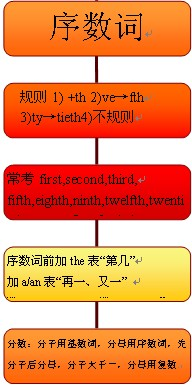
表示顺序的数称为序数词。如:first, second, third, fourth。
序数词的构成与用法:
1、序数词的构成:
①一般来说,是由相应的基数词加词尾th构成。
例:four+th→fourth
six+th→sixth
seven+th→seventh
ten+th→tenth
②下面这些基数词在变为序数词时,有特殊的变化。
例:one→first
two→second
three→third
five→fifth
eight→eighth
nine→ninth
twelve→twelfth
③十位整数序数词的构成方法是将基数词的词y变成i,然后再加eth。
例:twenty→twentieth
thirty→thirtieth
forty→fortieth
ninety→ninetieth
④两位或两位以上的基数词变成序数词时,仅将个位数变成序数词。
例:twenty-one→twenty-first
thirty-five→thirty-fifth
a hundred and fifty-three→a hundred and fifty-third
2、序数词的用法:
①序数词在使用时,一般加上定冠词。
例:the first book
the second floor
the third day
the fourth week.
②序数词在多数情况下都用作定语,有的也可以作表语、主语和宾语。
例:The may1st is Labour Day. 五月一日是劳动节。
My room is on the second floor. 我的房间在二楼。
The first is larger than the secon.(主语)第一个比第二个大。
Read the book from the first.(宾语)从开头读这本书。
You'll be the sixth to write.(表语)你将是第六个写的。
③序数词的前面可以加上不定冠词,用来表示“再一”,“又一”的意思。
例:You may have a third try. 你可以第三次尝试。
序数词知识体系:
约数的表达方法:
用tens/dozens/scores/hundreds/thousands/millions of 表示“几十、几百、上千、成千上万”等。
如:The boy bought dozens of pencils.
Thousands of people died in the earthquake.
注意: (A):dozen, score, hundred, thousand, million等表示确切数量时,不用复数。
如:five dozen (of) eggs 五打鸡蛋
hree hundred people 三百个人
分数词的构成和用法:
1)分数词构成法:
分数词(FractionalNumerals)由基数词和序数词构成,基数词代表分子,序数词代表分母。除了分子为1的情况下,序数词都要用复数形式:
如:1/4:one-fourth
5/9:five-ninths
2/3:two-thirds
17/5:three and two-fifths
7/12:seven-twelfths
379/8:forty-seven and three-eighths
此外还有下面表示法:
如:1/2:a(one) half
1/4:a(one) quarter
3/4:three-quarters
9/4:two and a quarter
3/2:one and half
31/4:seven and three quarters



